
Let's be honest: almost nobody reads contracts from start to finish. We scroll, we skim, we sign. Most of the time that's fine, because most of a contract is boring machinery that never matters.
But a few clauses do matter, and they tend to show up again and again in gym memberships, software subscriptions, leases, freelance agreements, supplier deals and job offers. If you only have five minutes, spend them on these.
1. Automatic renewal and notice periods
Look for words like "renews automatically", "rolling" or "unless cancelled". Many contracts quietly renew for another full term unless you cancel within a narrow window, often 30 to 90 days before the end date.
Ask: When does this end? Does it renew? How and by when do I have to cancel? Then put a reminder in your calendar the day you sign. Several countries now require businesses to remind consumers before a renewal, but don't count on it.
2. How you (and they) can end it
The termination clause tells you how to get out. Check whether you can end the contract early, what notice you have to give, and whether there's a fee. Then check the other side: can they end it at any time, for any reason, while you're locked in? Lopsided termination rights are a red flag.
3. Price changes
A clause saying the provider "may change prices at any time" or "on notice" means the deal you signed up for isn't necessarily the deal you'll keep. If you're a consumer, some legal systems limit this or give you the right to leave if prices go up. In business contracts, you usually get only what you negotiate.
Ask: Can the price go up during the term? By how much? Can I leave without penalty if it does?

4. Limits on liability
This is the clause that decides what happens if things go badly wrong. A limitation of liability clause often caps what the other side has to pay you, sometimes at a tiny figure such as the fees you paid in the last month. An exclusion clause may say they aren't responsible for certain kinds of loss at all, like lost profits or lost data.
Some of this is normal and reasonable. But imagine the worst realistic thing that could happen, then read the clause and ask whether the cap would even come close to covering it. Consumer protection laws in many countries prevent businesses from excluding liability for certain things, like death or injury caused by negligence, or basic quality standards. Between businesses, far more is allowed.
5. Indemnities
An indemnity is a promise to cover the other side's losses if something specific happens. "The Client shall indemnify the Supplier against all claims arising from…" means you pay if those claims arise, potentially without any cap.
Indemnities can be far more dangerous than they look, especially for freelancers and small businesses. If you see one, find out exactly what it covers, whether it's capped, and whether it's mutual. It's perfectly reasonable to ask for it to be narrowed or removed.
6. Non-competes, non-solicitation and exclusivity
These clauses restrict what you can do, often after the contract has ended:
- Non-compete: you can't work for competitors or start a competing business for a period of time.
- Non-solicitation: you can't approach the other side's clients or staff.
- Exclusivity: you can only work with or buy from this one party.
How enforceable these are varies enormously. Some countries and regions heavily restrict non-competes, particularly in employment; others enforce them if they're reasonable in length, geography and scope. Either way, don't sign one assuming it "won't be enforced". Negotiate it down first.
7. Who owns the work
For anyone creating something (designs, code, writing, photos), check the intellectual property clause. Does ownership pass to the client? When: on creation, or on payment? Can you show the work in your portfolio? Are you giving up rights to things you made before this project?
A small change, like "ownership passes on payment in full", can make a real difference if a client later refuses to pay.
8. Where disputes are decided
Near the end, often in small print, you'll usually find a clause about which country's law applies, which courts hear disputes, or whether disputes go to private arbitration. If the other side is abroad, this can mean that any disagreement has to be fought in their country, under their law, which may be completely unrealistic for you.
Consumers often have extra protection here, but businesses and freelancers usually don't.
9. "Entire agreement"
This innocent-looking clause says the written contract is the whole deal, and anything said or promised outside it doesn't count. So if the salesperson promised free setup, a discount or a feature that isn't in the document, it may not be enforceable.
The fix is easy: if something was promised, get it written into the contract before you sign.
10. Personal guarantees
If you run a company and sign a lease, loan or supplier agreement, look for a personal guarantee. It means that if the company can't pay, you personally can be pursued. That can undo much of the protection of running a limited company in the first place. Sometimes it's unavoidable. It should never be a surprise.
How to push back without awkwardness
Many people assume contracts are take-it-or-leave-it. Often they aren't, especially in business-to-business deals. A few approaches that work:
- Ask a simple question: "Can you explain what this clause means in practice?" Sometimes the answer reveals that nobody minds changing it.
- Propose specific wording, rather than just saying you don't like something.
- Make it mutual: if they can terminate on 30 days' notice, so should you.
- Don't accept "it's standard" as a reason. Standard for whom?
Before you sign: a five-minute checklist
- When does it end, and does it renew automatically?
- How can I get out, and what will it cost?
- Can the price change?
- If things go wrong, what's the most I can recover, and the most I could owe?
- Are there any indemnities or personal guarantees?
- Does anything restrict what I can do after this ends?
- Who owns what I create?
- Which country's courts deal with disputes?
- Are all the promises I was given actually in writing?
For anything big (a business lease, a large supplier contract, a job with significant restrictions), it's worth paying a lawyer to review it. It's almost always cheaper than finding out what a clause meant after the fact.
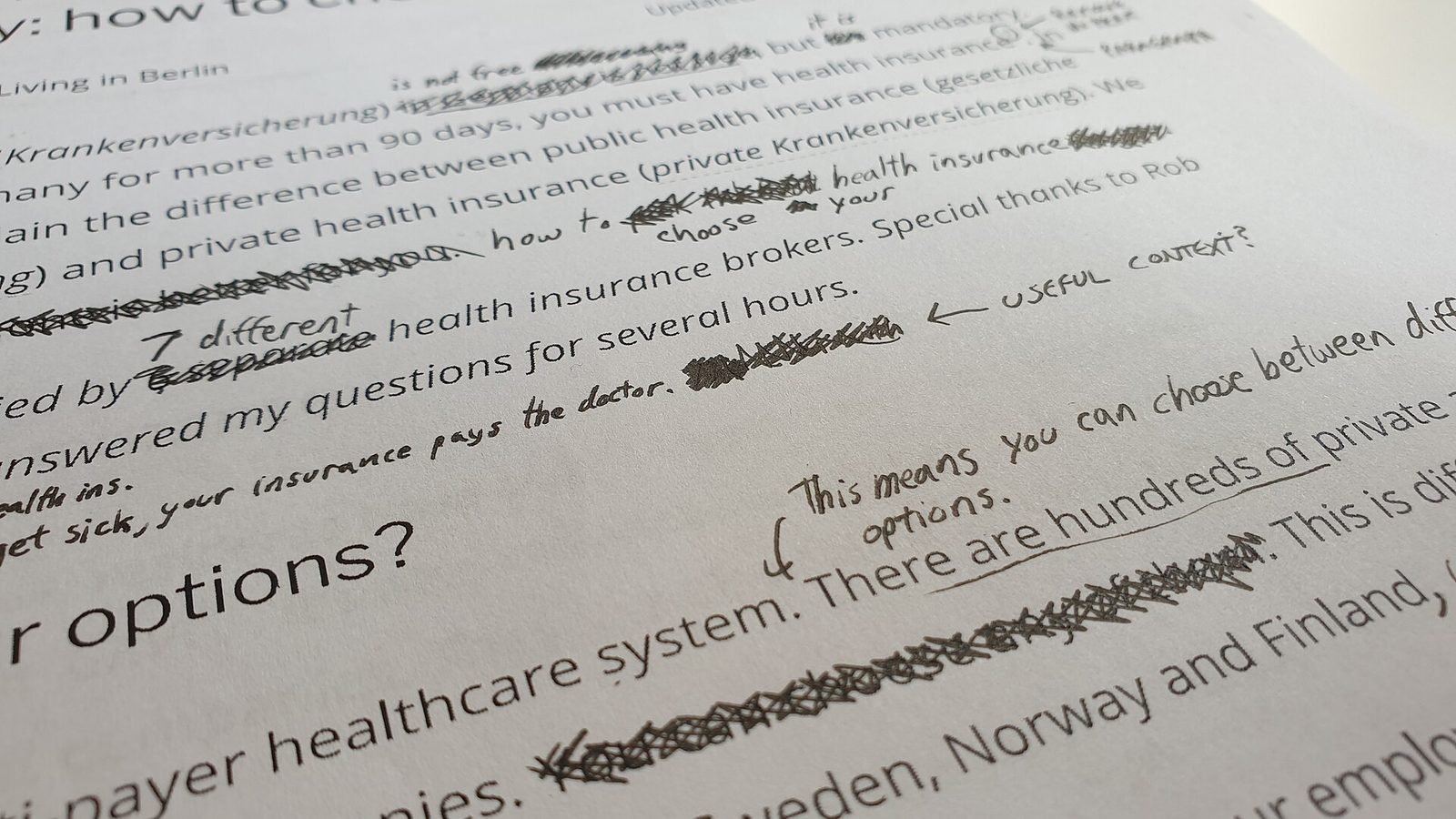
Photos via Wikimedia Commons: Pen revisions on a paper document by Nicolas Bouliane (CC BY-SA 4.0); Reading glasses by Mk2010 (CC BY-SA 3.0).